
Holding Liat
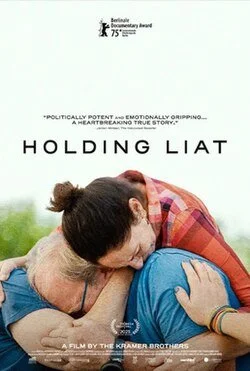
Liat Beinin Atzili and Yehuda Beinin
In early January, “Holding Liat” was theatrically released at the Film Forum in New York. The film is directed by Brandon Kramer and produced by his brother Lance Kramer of Meridian Hill Pictures “Holding Liat” tells the story of my niece, Liat Beinin Atzili’s abduction during the Hamas attack on her home, Kibbutz Nir Oz, on October 7, 2023, and the family’s efforts to secure her release. Liat was freed and reunited with her three children and the rest of my American-Israeli family after 54 days in captivity. Less than 24 hours later, she learned that her husband, Aviv, was killed while defending their kibbutz home on October 7.
The film was released in Los Angeles at the Laemmie Theaters on January 16 and will roll out in theaters around the country. In Portland, OR it will be shown at Cinema 21 on February 26 as part of the Jewish Film Festival and co-sponsored by the Oregon Jewish Museum and Holocaust Education Center.
Days after her abduction, Liat’s father, my brother Yehuda, began a fierce and determined campaign to secure Liat’s release while insisting that her abduction and the Hamas-led attack on Israel more broadly not be used to justify the annihilation of Palestinian society in the Gaza Strip (we lost that struggle). Liat’s mother Chaya, who lives with Yehuda on Kibbutz Shomrat, her sister Tal, who lives in Portland with her cat, Fidel, who has a cameo appearance, Liat’s sons, Ofri and Netta, and her daughter, Aya, and I all appear in the film. Our emotions are raw and the film boldly, but sensitively, depicts them and our differing views about these matters. We have been an unusually politicized family with longstanding differences of opinion about Israel/Palestine spanning three generations. But we were totally united around the objective of securing Liat’s (and Aviv’s until we learned of his death) release from captivity in Gaza. Palestinian Islamic Jihad released Aviv’s body in June 2025, days after the film’s US premiere at New York’s Tribeca Film Festival.
The film has been widely acclaimed, beginning with its world premiere at the Berlin International Film Festival in February 2025, where it won the Berlinale Documentary Film Award. It was shortlisted (final 15) for an Oscar in the Documentary Feature category.
The film’s director and producer, Brandon and Lance Kramer, are distant members of our family. This gave them exceptional access to many intimate moments, including divergent understandings of the meaning of Liat’s abduction, the best way to secure her release, and the appropriate contexts for understanding it.
On Friday, January 9, Amy Goodman of Democracy Now interviewed Liat and Brandon and Kaouther Ben Hania, the Tunisian writer and director of “The Voice of Hind Rajab.” Hind, a five-year-old Palestinian girl, was killed by Israeli forces in the Gaza Strip along with six members of her family as they were fleeing the Israeli assault on Gaza City. Israeli forces also killed two paramedics who were cleared to rescue her. “The Voice of Hind Rajab” is shortlisted for an Oscar in the International Feature Film category.
The on-air interview with Liat and Brandon is relatively short. Amy extended her interview with them after the broadcast and it is posted on the Democracy Now website. Amy previously interviewed me on Democracy Now about the sham Gaza “cease-fire” concluded on October 10, 2025 with some discussion of the film and related political issues.
Shortly after her release, Liat penned an op-ed for the New York Times, “Choosing Rebirth Over Revenge After My Release From Gaza.” She wrote, “I do not seek revenge for what I have been through…I do not feel any catharsis in seeing the destruction of Gaza…. I want to focus on building a better future for my three children — and for the children of Gaza.”
Sarah Wildman subsequently did an extensive interview with Liat for the New York Times. Liat explains that she has joined the Parents Circle-Families Forum, “a group of Palestinians and Israelis who have lost family members to the conflict and see more commonality in that loss than difference.”
Liat felt that she, “needed to be able to communicate with Palestinian women…and…to be in a place where people aren’t afraid to talk about peace and hope and to share their experience and their loss and to still want a different future. I really felt a need to be surrounded by people who relate to all these things in a similar way that I do.”
Liat concludes, “What happened in Israel on Oct. 7 doesn’t and can’t justify anything. I think that these questions aren’t discussed enough. What do we want to happen? What are Israel’s goals? How do we see the future? To me, that’s what it means to look beyond the fence (a reference to a comment Liat makes in the concluding scene of the film), to want to know what the price is.”