
Israel’s October 2026 Knesset Election 101
Israel’s Knesset (parliament) elections are scheduled for October 27. The political class and commentariat are in high campaign mode. For the last few months and until the election, virtually everything that has and will happen domestically and in Israel’s relations with its neighbors should be passed through the interpretive prism of electoral politics.
For example, on August 9 Prime Minister Netanyahu publicly rejected the 15-point Gaza “peace plan” of the Board of Peace appointed by President Trump. Many well-informed observers (for example, Mouin Rabbani, whose commentary is more astute than the Western corporate media) never believed that this plan or the Board of Peace itself were viable. That was not the point.
Netanyahu apparently thought that broadcasting his disagreement with President Trump would entice hard liners to vote for the Likud rather than the fascist-messianist parties in his coalition led by Minister of Finance Betzalel Smotrich (Religious Zionism) and Minister of National Security (i.e., police and prisons) Itamar Ben-Gvir (Jewish Power). Those parties will certainly be part of any coalition that Netanyahu might hope to assemble after the October 27 election. But he will be stronger in relation to his potential coalition partners the more seats the Likud wins. Netanyahu also needed to shore up his standing with the noisy Jewish supremacists in the Likud itself.
According to an August 19 poll by Israel’s public broadcaster Channel 13, the parties that make up Israel’s current government - Likud, Religious Zionism, Jewish Power, Sephardic Torah Guardians (Mizrahi ultra-orthodox or Shas), and halfheartedly, United Torah Judaism (Ashkenazi ultra-orthodox) would get 51 Knesset seats. That is, 10 less than the 61 required to win a vote of confidence in the 120-member Knesset and form a government. Only one polling firm associated with the Likud has produced recent numbers giving the current government parties a Knesset majority.
Those who look forward to ousting Israel’s current government have been heartened by the recent polls. The same Channel 13 poll gives the bloc of Jewish anti-Netanyahu parties led by retired IDF chief-of-staff Gadi Eisenkot’s Yashar (Straight or Honest) Party 59 Knesset seats, two short of a majority. With that number of seats they could not form a government without including one or more parties comprised primarily of Israel’s Palestinian Arab citizens.
All but one of the Jewish parties have declared they would oppose including Arab parties in a coalition government – proclamations that highlight the nearly eight-decade norm in Israeli politics. Palestinian Arabs, who comprise about 20% of Israeli citizens, may participate politically; they cannot have a meaningful share of power.
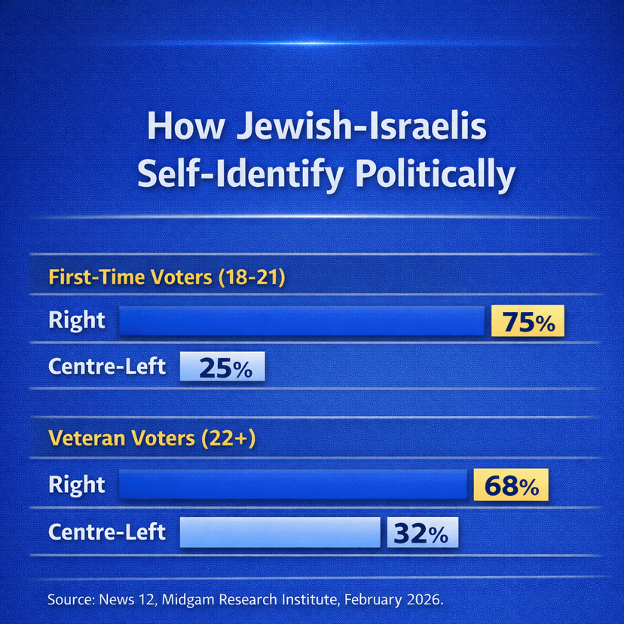
Both the current ruling coalition and the Jewish parties that seek to replace it are Jewish supremacists. They all supported the Iran war, the invasion of Lebanon, and the genocide in Gaza. They opposed Trump’s “ceasefire” with Iran and hoped that continuing Israeli aggressive actions in Lebanon would blow it up. They don’t want to talk about ending the occupation, two states, or Palestinian rights in any form. They don’t want to talk about equality for Palestinian citizens of Israel. Those positions are supported by the great majority of the Israeli Jewish public. It would take a lot of political courage, a commodity in short supply among Israeli political figures, to speak out in favor of a different and better future.
Should the anti-Netanyahu bloc win the election and succeed in forming a government, the messianist-fascists Ben-Gvir and Smotrich and the morally debased Netanyahu, who is still on trial facing three counts of corruption, would be out of government. Disempowering these highly toxic individuals would be a significant improvement. But, like President Donald Trump, they are symptoms of political and social decay, not its causes.
The bloc of Jewish parties seeking to replace Netanyahu would install a government that will be cleaner, less inclined to authoritarianism, less sympathetic to messianism, and more likely to draft the ultra-orthodox (haredim) into the army. These parties want to frame the election campaign as “Netanyahu yes” or "Netanyahu no.” They don’t want an election contested on a left/right or any ideological axis.
The main beneficiaries of the changes they would likely make are secular Jewish residents of greater Tel Aviv and middle-class Jews more generally.
On August 19 three of the four mainly Arab parties - the communist-led Democratic Front for Peace and Equality (or Hadash), the Arab nationalist National Democratic Alliance (or Balad), and the Arab Movement for Renewal (or Ta’al), a personal vehicle for Ahmad Tibi, announced they would reconstitute the Joint List that won 15 Knesset seats in the 2020 Knesset elections (when it comprised 4 parties) before the collapse of the fragile unity of its ideologically disparate elements. The Islamist United Arab List (or Ra’am) has declined to join the revived Joint List.
In the November 2022 elections the three Arab parties that entered the current Knesset won 10 seats. Five of them are held by Ra’am. Balad did not win enough votes running alone to enter the Knesset.
The one Jewish party willing to countenance Arab participation in the government is The Democrats (a merger of Labor and Meretz), led by former deputy IDF chief-of-staff Yair Golan.
The Democrats are projected to win 9-11 Knesset seats. If its leaders like Golan,
feminist social democrat Naama Lazimi or Reform Rabbi Gilad Kariv were to join an Israeli government, they might be able to block some outrageous “excesses.” Their presence in the government would encourage Israeli and diaspora Jews to imagine that a substantive political change had occurred and that some version of "beautiful Israel” (which never really existed, but that’s a story for a different column) can be restored. However, the Democrats will have at best a minor voice in shaping the policies of the anti-Netanyahu bloc should it form a government.
Democrats leader Golan has said that Ra’am would be an acceptable coalition partner. Its acceptability would be enhanced if Yoav Segalovitz, currently an MK for There is a Future (Yesh Atid) were to join Ra’am. Ra’am leader Mansur Abbas is keen to see this happen because he has been trying to move his party beyond the confines of its Islamist origins. If Golan can convince his Jewish partners that Ra’am is kosher, there is a path towards the anti-Netanyahu bloc forming the next Israeli government.
On the DSA-like left fringe of the Israeli political spectrum, the Arab-Jewish social movement Standing Together has formed a political party, A Place for All of Us (Makom Lekulanu). Think, applying New York Mayor Zohran Mamdani’s bread and butter “affordability” strategy in Israel. This has never before worked in Israeli politics.
Since the second intifada, most Israeli parties haven’t wanted to talk about the possibility of peace, certainly not a peace including a sovereign Palestinian state. Parties that were seen as favoring “peace” had steadily lost standing with the Israeli public for over two decades before October 7, 2023 (hence the merger of Labor and Meretz to form The Democrats).
A Place for All of Us leaders have said that if polls indicate that they will not attain the minimum of 3.25% of the total votes required to enter the Knesset they will withdraw from the race. Today, there appears to be little chance they can pass the electoral threshold.
If A Place for All of Us campaigns and withdraws, then no harm will have been done. They will have achieved a platform to advance the argument that the only way to change what needs to be changed in Israel is Jewish-Arab collaboration on the basis of equality. If A Place for All of Us remains in the race despite polls indicating they won’t obtain 3.25% of the vote, then they will be (they have already been) accused of sabotaging the anti-Netanyahu bloc by splintering the small number of votes for parties of the left.
Israeli polling is notoriously unreliable. The two months between now and the election are a long time in politics. Polls are only an approximation of opinion at a moment in time. Haaretz columnist Dahlia Scheindlin is the most sophisticated interpreter of Israeli polls. Those interested in following the horse race can benefit from her guidance.